
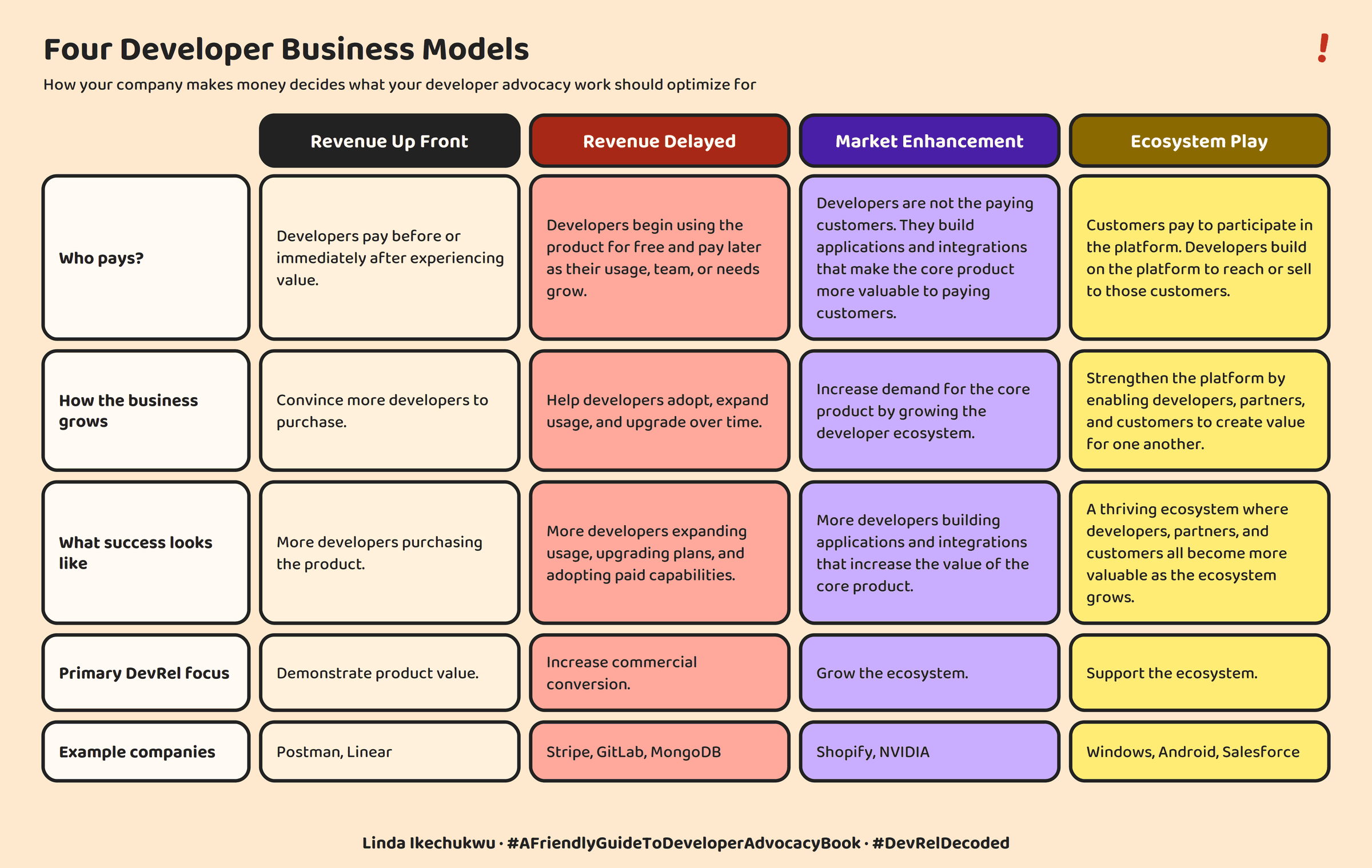
A company’s monetization strategy describes how it captures value from the products or services it offers. In this article, we’ll look at four common monetization strategies: Revenue Upfront, Delayed Revenue, Market Enhancement, and Ecosystem Play. Each one influences what the business ultimately considers valuable and, therefore, what success looks like for developer advocacy.
In the introductory article for this series, we talked about the strategic analysis you need to do before deciding what to build, write, or launch as a developer advocate. To gain a comprehensive understanding of the business, you need to analyze three areas: the company, the team, and the product and its users.
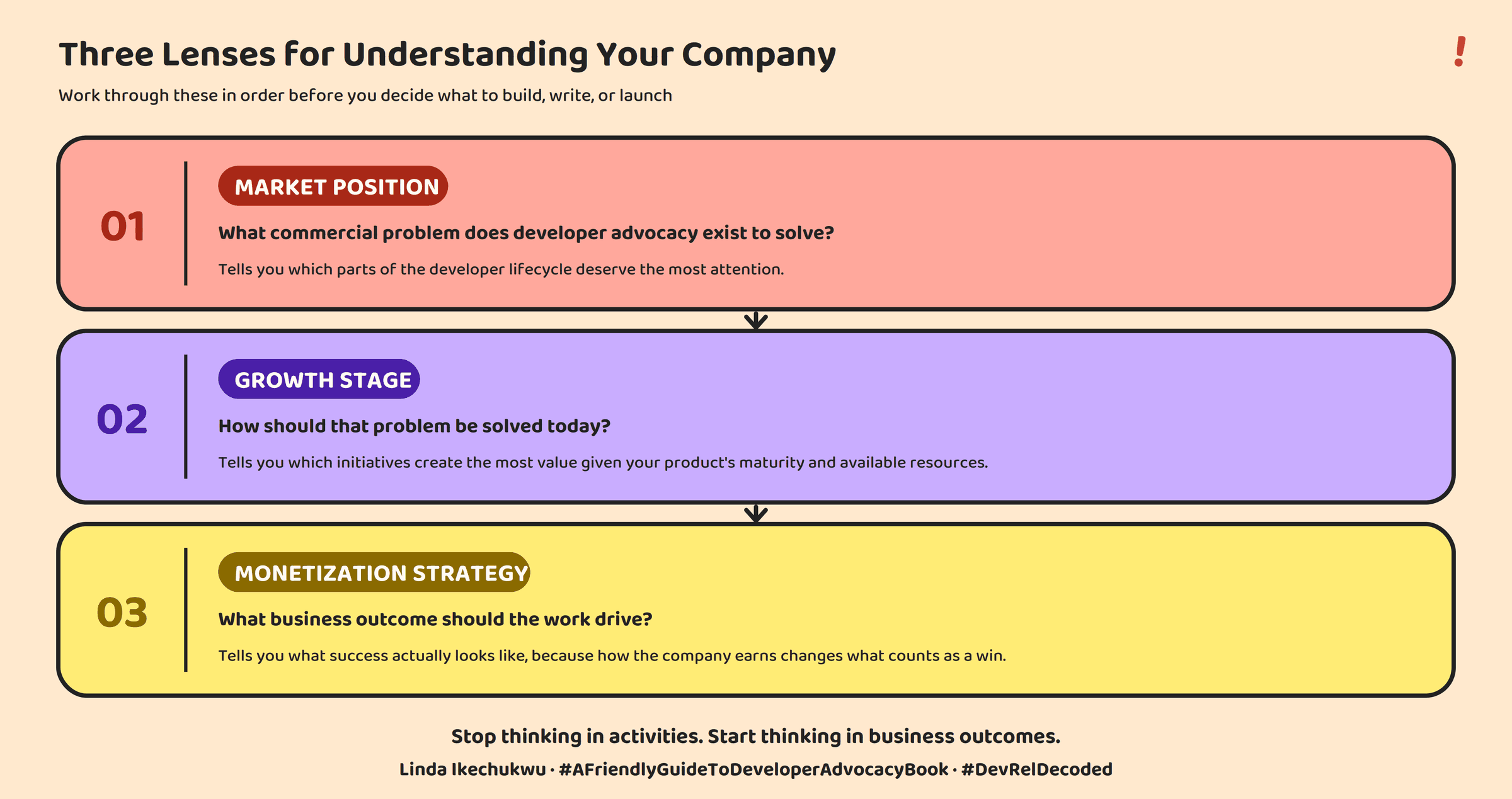
When analyzing the company, you need to look at it through three lenses: its market position, its growth stage, and its monetization strategy.
In Part 1, we looked at how understanding your company’s market position helps you identify the commercial challenge it is trying to solve. Whether your company is a market leader, challenger, niche player, or shooting star influences the broad customer lifecycle outcomes that are likely to deserve the most attention.
In Part 2, we built on that by looking at your company’s growth stage. Once you have identified the customer lifecycle stages that matter most, your company’s growth stage helps you determine which developer advocacy initiatives within those stages are likely to create the most value, given the state of your product and the resources available to the business.
This article explores the final piece of understanding your company: its monetization strategy. Because two companies can have the same market position and be at the same stage of growth, yet require completely different developer advocacy strategies because they make money in different ways.
By the end of this article, you’ll be able to identify your company’s monetization strategy and understand how it should influence the outcomes your developer advocacy efforts are designed to create. Because if you don’t understand how your company makes money, you’ll struggle to explain how your work helps it make more of it.
Understanding Your Company’s Business Monetization Model
Understanding your company’s monetization strategy means drilling down into how it actually captures value from the products or services it offers. That answer isn’t always as straightforward as “customers pay for the product.”
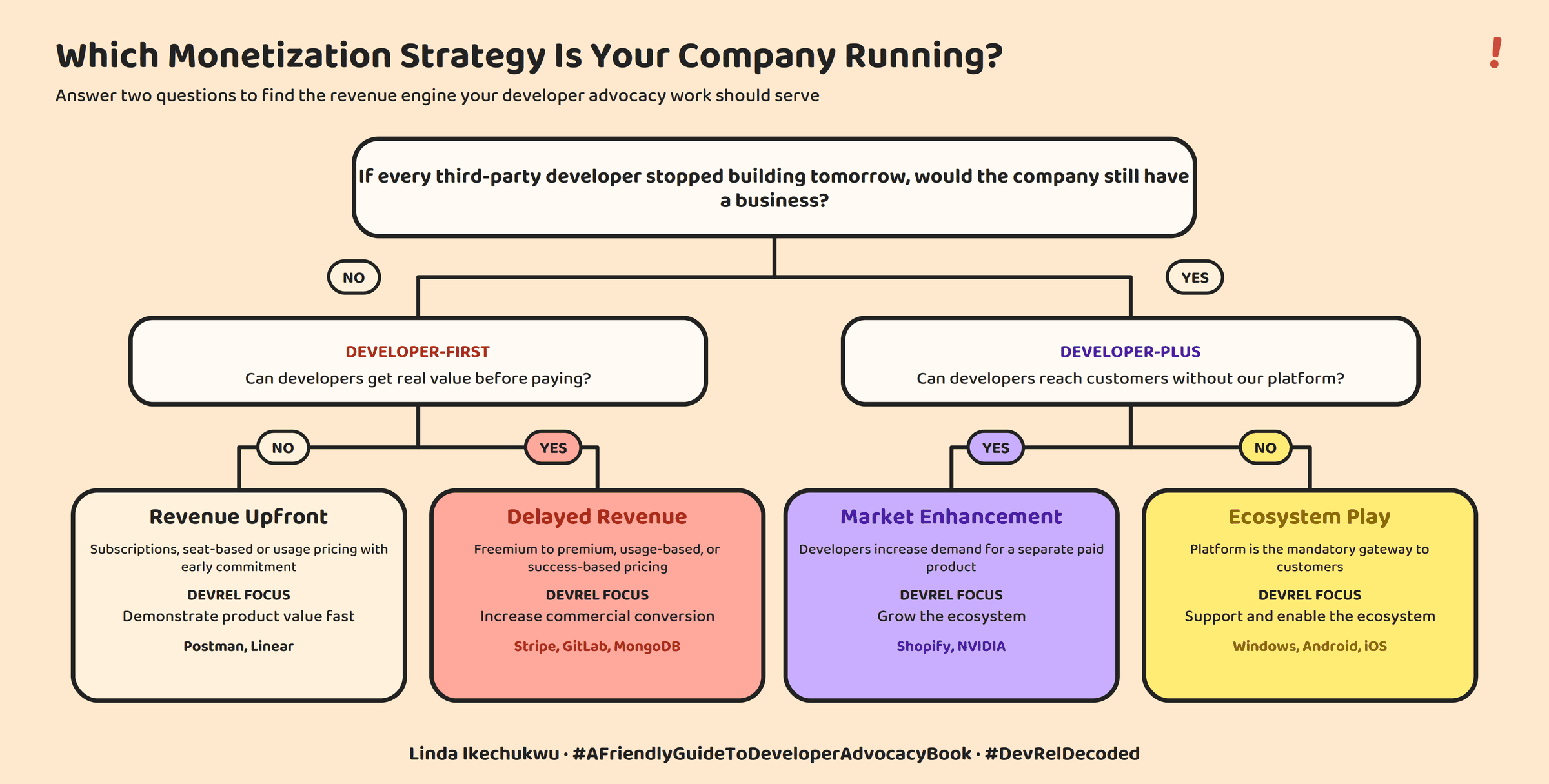
Broadly speaking, companies with a developer audience tend to follow one of two business models: Developer-First or Developer-Plus. Your company’s business model directly shapes its monetization strategy and, ultimately, what developer advocacy can help achieve.
In Developer-First companies, developers are the primary customer. The product is built for them, sold to them, and succeeds or fails based on their experience. The company makes money when developers adopt the product, experience value, and either pay for it themselves or influence the people who do.
In Developer-Plus companies, developers are not the end customer. Instead, they enable or extend the business’s reach to a broader market. The company invests in developers because their adoption, education, and success create value elsewhere in the business, even if those developers never become paying customers themselves.
Because each business model captures value differently, it also shapes how the company measures success and the kind of impact developer advocacy can deliver.
| Characteristic | Developer-First | Developer-Plus |
|---|---|---|
| Core audience | Developers | Developers + business stakeholders |
| Revenue model | Directly tied to developer adoption | Broader B2B / B2C monetization |
| Product interface | Code-first, built for devs | May include SDKs, APIs, or dev portals |
| DevRel focus | Community, adoption, feedback, scale | Enablement, integrations, cross-functional impact |
| Internal positioning | Core to product growth | One function among many |
How Developer-First and Developer-Plus companies differ, and what that means for where DevRel sits in each.
Developer-First companies monetize through either Revenue Upfront or Delayed Revenue, while Developer-Plus companies typically follow either a Market Enhancement or Ecosystem Play strategy. Let’s look at each one and what it means for your developer advocacy strategy.
Developer-First Companies
In a Developer-First company, developers are at the center of the business. The product is built for them, sold to them, and succeeds or fails based on their experience. If developers don’t adopt the product, the business struggles to generate revenue.
You’ll typically find this business model among companies building developer tools such as APIs, databases, cloud platforms, CI/CD tools, observability platforms, security products, and developer productivity tools. Whether the product is sold through self-service subscriptions, usage-based pricing, or enterprise contracts, developer adoption is central to the company’s success.
Within the Developer-First business model, companies generally monetize in one of two ways:
- Revenue Upfront, where customers begin paying shortly after adopting the product.
- Delayed Revenue, where developers can use the product for an extended period before revenue is generated.
Although both models depend on developer adoption, they capture value at different points in the developer journey. Let’s look at each one.
Revenue Upfront
Companies following a Revenue Upfront strategy generate revenue shortly after developers begin using the product. This is common among SaaS products with subscriptions, seat-based licensing, or usage-based pricing where customers commit early, often after a short trial.
One of the easiest ways to recognize this strategy is to ask, “How long does it typically take for a new developer to become a paying customer?” If the answer is days or weeks rather than months or years, your company is probably operating a Revenue Upfront model.
Think of companies like Postman, Datadog, or CircleCI. A developer can discover the product, evaluate it, start using it, and become a paying customer within a relatively short period if they experience value quickly.
What does this mean for developer advocacy?
Developer advocacy is likely to create the most value by reducing friction throughout the onboarding experience and helping developers become successful as quickly as possible. This may look like prioritizing initiatives such as:
- Creating quick-start guides that help developers achieve their first success in minutes.
- Producing clear onboarding tutorials and sample applications.
- Building integrations that fit naturally into developers’ existing workflows.
- Improving documentation so developers can find answers without unnecessary friction.
- Supporting community forums where developers can quickly unblock themselves and continue building.
The faster developers move from “I’m trying this product” to “I’m successfully using this product,” the more value DevRel creates for the business.
Delayed Revenue
Companies following a Delayed Revenue strategy don’t generate revenue immediately after developers adopt the product. Instead, they capture value after a specific milestone, usage threshold, or time delay. Developers are encouraged to experiment, build, and grow with the product before the business ever asks them to pay.
It might look like:
- Freemium to Premium: Offering core functionality for free and monetizing when users upgrade for advanced features.
- Usage-Based Pricing: Billing customers based on API calls, storage, compute, or other usage after the product has been adopted.
- Success-Based Pricing: Recognizing revenue only after the customer achieves a specific outcome or milestone.
One of the easiest ways to recognize this strategy is to ask, “Can developers get meaningful value from our product for an extended period before becoming paying customers?” If the answer is yes, your company is likely operating a Delayed Revenue model.
Think of companies like Stripe, GitLab, MongoDB, Netlify, or Redis. A developer might discover the product today, build with it for months, and only become a paying customer once their application reaches production, their team grows, or they need enterprise capabilities.
What does this mean for developer advocacy?
The C-suite’s biggest fear in a Delayed Revenue model is churn before monetization. The longer developers continue building with the product, the greater the opportunity for future commercial conversion. If a developer signs up but gets frustrated and leaves after three weeks, the company loses money on infrastructure and marketing without ever seeing a dime.
Developer advocacy creates the most value by increasing Developer Lifetime Value (DLV): helping developers stay engaged throughout the long building phase, reducing churn before monetization, and educating developers on the value of paid features so that commercial conversion becomes a natural next step.
This may look like:
- Value advocacy: Create tutorials, reference architectures, and sample applications that naturally incorporate enterprise capabilities such as clustering, SSO, RBAC, audit logs, or advanced security. Show developers how paid features solve real-world, high-scale problems, and focus on solving Day Two production problems so they naturally discover the value of premium features as their applications grow. For example, rather than creating another introductory tutorial, you might focus on publishing content such as:
- How to handle 10,000 requests per second using Advanced Clustering.
- Building a production-ready application with Single Sign-On (SSO), role-based access control (RBAC), and audit logging.
- Setting up enterprise-grade monitoring and alerting for distributed teams.
- Reducing churn and lowering support costs through community support at scale: As free user bases grow into the tens of thousands, answering every technical question one-on-one quickly becomes financially unsustainable. Developer advocacy creates value by scaling technical enablement through reusable documentation, tutorials, community forums, reference architectures, and contextual AI assistants that allow thousands of developers to self-serve while staying engaged long enough to reach commercial milestones.
- Surfacing product feedback: If developers love the product but consistently stop short of upgrading, investigate why. DevRel sits closest to the developer community and can identify which enterprise features customers actually want, helping Product prioritize capabilities the market is willing to pay for.
- Growing the top of the funnel with the right developers: Delayed Revenue businesses still need a steady stream of qualified developers entering the product. Invest in awareness content that targets developers trying to solve the kinds of problems your paid offering solves best. A larger pool of qualified users creates more opportunities for future commercial conversion.
Developer-Plus Companies
Unlike Developer-First companies, where developers are the primary customer, Developer-Plus companies generate revenue from someone else. Developers are still a critical audience, but they create value by enabling, extending, or increasing the adoption of another product, platform, or business.
You’ll typically find this business model among hardware companies, operating system vendors, enterprise software platforms, marketplaces, consumer technology companies, and SaaS products that expose APIs or developer platforms to extend the value of their core product. Examples include NVIDIA, Apple, Microsoft, Shopify, Salesforce, Unity, HubSpot, and Figma.
If you’re unsure which category your company falls into, ask yourself this simple question:
If every third-party developer stopped building integrations, extensions, or applications tomorrow, would the company still have a business?
If the answer is yes, but the product or platform would become significantly less valuable to its primary customers, you’re likely looking at a Developer-Plus company. Developers aren’t the customer. They’re helping create value for the people who are.
For example:
- Stripe: No. Developers are the primary customers.
- PostHog: No. Same.
- Shopify: Yes. Merchants can still sell products, but the platform becomes significantly more valuable because of third-party apps.
- Salesforce: Yes. Businesses can still use Salesforce, but apps and integrations make the platform far more valuable.
- Apple: Yes. People would still buy iPhones, but the App Store is a major reason the ecosystem is so valuable.
- NVIDIA: Yes. Customers would still buy GPUs, but CUDA applications increase demand for those GPUs.
Within the Developer-Plus business model, companies generally monetize in one of two ways:
- Market Enhancement, where investing in developers increases demand for another revenue-generating product or service.
- Ecosystem Play, where the business creates value by growing an ecosystem of developers, partners, and applications around its platform.
Let’s look at each one.
Market Enhancement
Companies following a Market Enhancement strategy generate revenue by selling one product or service but invest in developers because doing so increases demand for that core business. Rather than monetizing developers directly, they monetize the additional value developer adoption creates.
You’ll commonly find this model among hardware companies, operating system vendors, enterprise software platforms, marketplaces, financial institutions exposing APIs, telecommunications companies, and SaaS products that provide developer platforms to extend the value of their core offering.
One of the easiest ways to recognize this strategy is to ask, “Does the company make more money when more developers build on top of its platform, even if those developers never become paying customers?”
If the answer is yes, your company is likely operating a Market Enhancement strategy.
Take Shopify as an example. Shopify makes money from merchants paying a subscription to run their online stores. Most merchants don’t know how to build software, so Shopify invests heavily in developers who create apps, themes, and integrations for its App Store. Those developers aren’t Shopify’s paying customers. They make Shopify’s platform significantly more valuable by solving problems Shopify’s own engineering team doesn’t have the time or resources to solve itself. A merchant comparing ecommerce platforms is far more likely to choose Shopify because thousands of specialized apps already exist to extend it. Developer success directly increases the value of Shopify’s core product.
Apple follows a similar strategy. Apple doesn’t make billions from Xcode or its developer tools. Xcode is free, Swift is open source, and the annual Apple Developer Program fee is insignificant compared to the revenue generated by the iPhone business. Apple invests heavily in developers because developers build iOS apps, and iOS apps sell iPhones.
Likewise, a bank may invest in APIs and developer documentation, not because developers generate revenue directly, but because every successful integration increases demand for the bank’s payment or financial services.
What does this mean for developer advocacy?
For companies operating this business model, the entire job of developer advocacy is to help developers build the applications, integrations, and extensions that make the company’s core product more valuable to paying customers.
Developer advocacy is likely to create the most value by:
- Increasing the value of the core product: Help more developers successfully build on your platform through tutorials, documentation, SDKs, CLIs, sample applications, and clear API documentation. Every successful integration, application, or extension makes the core product more useful and attractive to paying customers.
- Filling ecosystem gaps: Instead of hoping developers build what your customers need, actively guide the ecosystem toward high-value opportunities. Run “App Gap” hackathons around missing integrations, publish ecosystem wishlists based on customer demand, or highlight underserved use cases. This helps the ecosystem evolve in ways that directly support business growth.
- Strengthening the developer platform through feedback: Work closely with your most successful developers to understand what technical limitations are slowing them down. Developer advisory boards, office hours, and community conversations can uncover missing APIs, SDK improvements, documentation gaps, and tooling issues. Feeding those insights back to Product helps remove friction for the entire ecosystem and enables developers to build even more valuable solutions.
- Growing a thriving developer ecosystem: Celebrate developer success by showcasing community-built applications, integrations, and extensions through case studies, demos, newsletters, and events. Every successful solution increases the value of the platform for customers while attracting even more developers to build on it.
Ecosystem Play
An Ecosystem Play strategy takes the concept of value multiplication even further than a Market Enhancement strategy. Instead of simply driving demand back to a core product, the company’s goal is to become the central coordinator of an entire ecosystem of developers, partners, and customers, or the foundational infrastructure that an entire industry depends on.
You’ll commonly find this strategy among operating systems, enterprise application platforms, cloud marketplaces, and other businesses that serve as the foundation for an entire ecosystem.
One of the easiest ways to recognize this strategy is to ask, “Can developers reach their customers without going through our platform?”
If the answer is no, or not in any meaningful way, your company is likely operating an Ecosystem Play strategy.
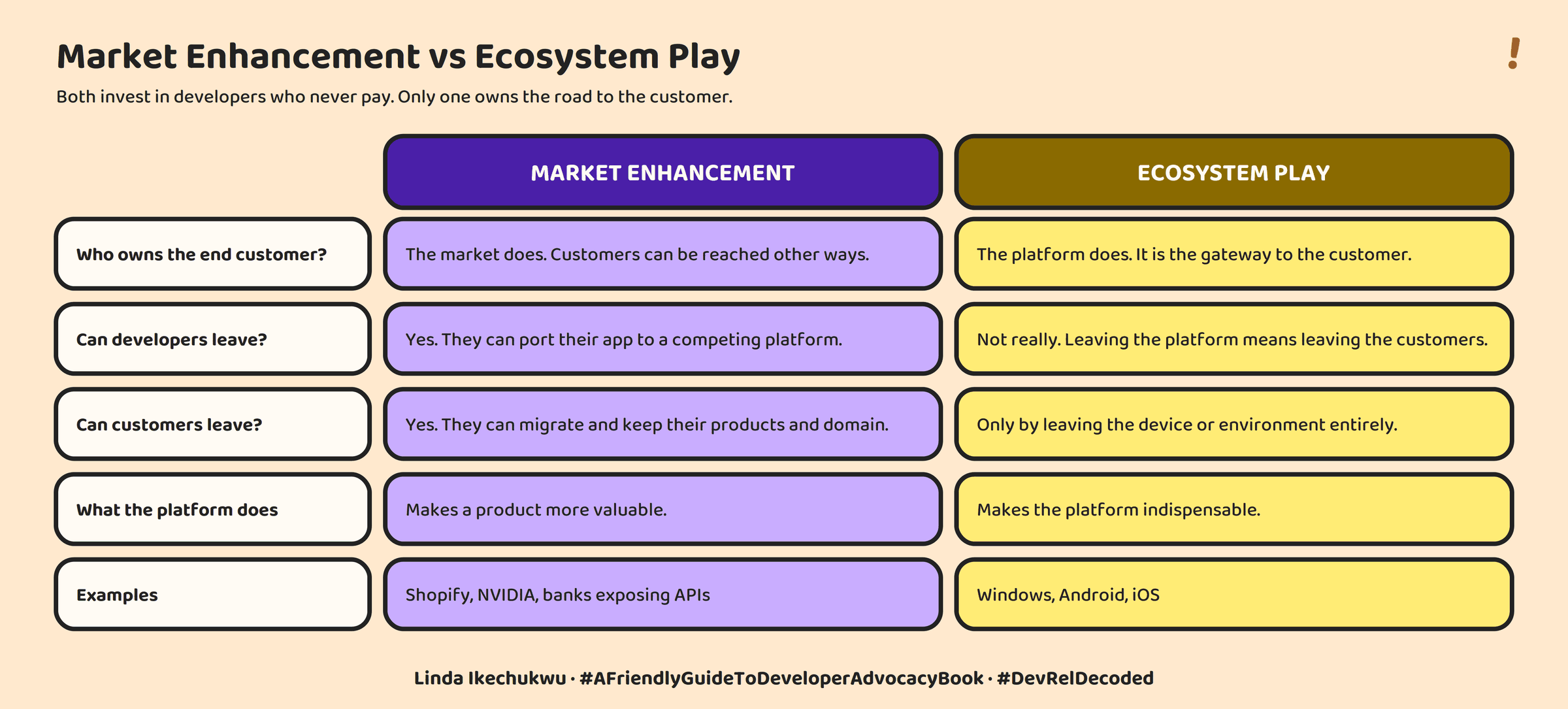
The easiest way to distinguish an Ecosystem Play from a Market Enhancement strategy is to look at who owns the relationship with the end customer.
In a Market Enhancement strategy, the platform exists to make a product more attractive, but the market itself remains open. Developers are encouraged to build because the marketplace is commercially attractive, but customers and developers can leave the platform without leaving the industry.
An Ecosystem Play is fundamentally different. The platform becomes the mandatory gateway between developers and customers. If you don’t build for the platform, follow its technical standards, and distribute through its infrastructure, you simply can’t reach the customers who live there. The company doesn’t just participate in the market. It controls the primary route into it.
Windows and Android illustrate this well. Consumers don’t simply buy “computer software” or “a mobile app.” They buy Windows software or download Android apps from the Google Play Store. The operating system owns the environment running on the customer’s device and defines the standards software must meet to run there. If you don’t build for Windows or Android, your application cannot natively execute on those devices. The platform controls the infrastructure that connects developers to end users.
Now contrast that with Shopify.
Shopify’s App Store undoubtedly makes the platform more valuable, but neither merchants nor developers are fundamentally tied to Shopify. If a merchant decides to leave, they can migrate to WooCommerce, Magento, BigCommerce, or even a completely custom ecommerce website while keeping their products, customers, and domain name. Likewise, if a developer no longer wants to build for Shopify, they can adapt their application for WooCommerce, Magento, BigCommerce, or sell it independently because the ecommerce market itself is open. Shopify enhances digital commerce, but it doesn’t own the gateway between merchants and customers.
That’s the defining difference.
A Market Enhancement strategy makes a product more valuable.
An Ecosystem Play makes the platform itself indispensable.
What does this mean for developer advocacy?
Unlike the other monetization strategies we’ve discussed, companies pursuing an Ecosystem Play are rarely struggling to convince developers to adopt the platform. If you’re building an iPhone app, you have to build for iOS. If you’re building desktop software for Windows users, you have to build for Windows. The platform’s position in the market has already solved the awareness and adoption problem.
That shifts the role of developer advocacy.
Rather than optimizing for developer adoption, developer advocacy is primarily focused on developer enablement. The goal is to remove every technical obstacle that prevents developers, partners, and businesses from successfully building, shipping, and growing on the platform. The easier it is for external developers to succeed, the stronger and more valuable the ecosystem becomes.
Developer advocacy is likely to create the most value by:
- Accelerating developer success: Create exceptional documentation, sample applications, SDKs, reference architectures, and technical content that help developers quickly understand and adopt new platform capabilities. The goal is to reduce the time between announcing a new capability and seeing it adopted across the ecosystem.
- Providing high-touch technical enablement: Run developer labs, office hours, technical consultations, and workshops where external teams can receive direct guidance on implementing new APIs, optimizing performance, or preparing for major platform releases. These programs remove friction that could otherwise delay adoption across the ecosystem.
- Surfacing ecosystem feedback: Because Developer Relations works closely with developers, it is uniquely positioned to identify confusing APIs, documentation gaps, missing tooling, and platform pain points. Bringing those insights back to engineering and product teams helps shape future platform releases and improves the experience for every developer building on the ecosystem.
- Preparing the ecosystem for platform evolution: Every major platform release creates work for thousands of developers. Developer advocacy helps the ecosystem transition smoothly by publishing migration guides, explaining breaking changes, demonstrating new capabilities, and educating developers long before new releases become mandatory.
Bringing It All Together
Developer Relations is not a one-size-fits-all discipline. To craft a developer advocacy strategy and consistently deliver undeniable, executive-level value, you must align your daily activities with the precise revenue engine running under your company’s hood.
By now, you should have a much clearer understanding of how to analyze your company before deciding where to invest your time as a developer advocate.
Your company’s market position tells you which parts of the developer lifecycle deserve the most attention.
Its growth stage helps you determine which developer advocacy initiatives under those stages are most likely to create value given the maturity of your product and the resources available to the business.
Finally, its monetization strategy explains the business outcomes those initiatives should ultimately drive. Whether your company generates revenue upfront, after long-term product adoption, by enhancing another product, or by orchestrating an ecosystem fundamentally changes what success looks like for Developer Relations.
When you combine these three lenses, you stop thinking in terms of activities and start thinking in terms of business outcomes. Instead of asking, “Should I write another tutorial or speak at another conference?” you begin asking, “Which initiative is most likely to help this business achieve the outcome it’s optimizing for?”
But understanding your company is only one part of the strategic analysis.
The next step is understanding the product and the developers it serves. Two companies can share the same market position, growth stage, and monetization strategy, yet require very different developer advocacy strategies because they solve different problems for different audiences. Understanding the product, its users, and where developers experience friction will help you refine your strategy even further.
We’ll explore that in the next article.
Only after you’ve understood the company, the product and its users, and finally the team around you do you have everything you need to build a developer advocacy strategy that is grounded in business reality rather than guesswork.